
Balance of Air

Air both affects and is affected. What influences it most are pressure differences. To control pressure differences, in a way, is to control air. Breathing is the most visible example of this management of pressure differences. Breathing, in fact, is quite fascinating. Some muscles in our body we govern with our conscious will: we move the muscles of our arm and chest to lift an arm, or command our legs to move in order to walk. And there are muscles the body manages on its own: our stomach digests by itself, we cannot order it to “start digesting” or “stop now.” Our liver cannot be directed by our will.
But breath is both conscious and automatic. We can decide to breathe slower, faster, shallowly, or deeply. Yet even when we make no such decision, it doesn’t stop—our breathing continues even while we sleep. This is why breathing is truly a form of communication with our inner world: it is an act we carry out jointly, and the healthier this communication is, the healthier the body responds in return.
But when the scale of pressure differences grows larger, we lack the power to intervene. What must be done then is to correctly recognize the force of the difference that has arisen. The device called a barometer serves to measure the pressure of the air. With its invention, humankind became capable of predicting approaching weather events.
Our first task in balancing the Air element is to discover our personal barometers and, with their help, learn to notice coming changes ahead of time. For example: we said that curiosity, the movement that stirs the mind, is born from the temperature and pressure differences between knowledge and ignorance. Noticing the state of that curiosity and keeping it balanced can provide a very good starting point for balancing our Air element. If it has waned, find what will nourish it; if it has grown to harmful excess, seek to calm it.

Air is the invisible. To “see” it, you must do other things. You can prove its existence indirectly—for instance, fire will not burn without air. You can seek its traces by observing your surroundings. If the leaves of trees are trembling, if foam gathers on the waves of the sea, if the clouds race across the sky as if in a hurry, then the wind is passing right there.
Sometimes you only feel its presence—in the way it fills your lungs. At high altitude it feels different than by the sea; different in a long-closed storeroom than in a breezy pine forest.
Thoughts, ideas, the things accumulated in your mind or body—these are also there, even if you cannot directly see them. You must exert effort to make them visible. Testing your thoughts, checking whether they are truly there, does no harm. And you don’t necessarily need exams to do this; simple observation can reveal them too. They always touch somewhere inside you; discovering that is always in your hands. And of course, you can feel them: have they grown heavy from being locked away, or scattered to pieces by winds blowing from all directions? What you feel—whether constriction or relief—is your responsibility to know and interpret.

Air wants space. It longs to spread, to reach, to carry. If air stays motionless, it suffocates—and suffocates you. As it moves, its energy grows. Here too, balance must be well established. Sometimes you speak, and speaking feels good; if you hold too much inside, it grows heavy over time, making you sick. The more you speak, the lighter you feel, so you keep talking. Then one day you suddenly realize you have scattered yourself: your words are losing meaning, you cannot even follow what you yourself are saying. You turn inward, and find yourself emptied out, lost.
If you lack the power to create your own wind, the best solution is to learn how to relate rightly with the wind itself. Early sailors made a mistake in how they built sailboats: the old sails were mounted perpendicular to the hull, so ships were expected to move only with the wind at their back. This created two problems. First, in downwind sailing, the wind’s direction is decisive: the ship can only go where the wind blows. If one wanted to go elsewhere, one had to wait for the wind to shift. Sailing against the wind was impossible. Second, even if the right wind came, the ship could go no faster than the speed of the wind itself. The sail filled, and the ship moved with it.
In modern sailboats, the sail can be shaped according to the wind and its position adjusted to need. With this innovation, the wind’s direction lost its absolute control. Now the ship can move in the direction it chooses—even against the wind. Moreover, the ship’s speed no longer has to be capped by the speed of the wind. For instance, in a sailing technique called close-hauled, where the wind is taken at a 90-degree angle, the ship’s speed can exceed the wind’s.
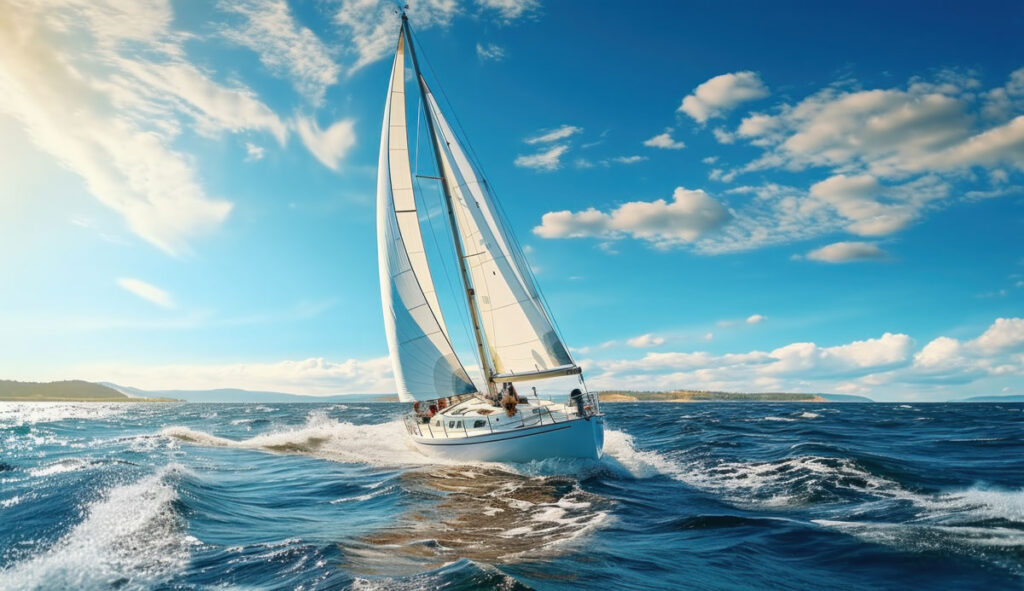
This is to say: when you stop thinking one-dimensionally and allow ideas to circulate around, new inventions become possible. As you learn to control your mental sail, you no longer need to wait for the wind that blows in your desired direction. You yourself can choose which wind to fill your sails with. Over time, you may even grow more sails, learn to use different kinds according to need, and even combine them to make the best arrangement. Of course, this doesn’t happen all at once. It comes by trying, failing, trying again, and learning.
But it is not without important rules. Even the most seasoned sailor never sets sail in a storm. And yet, “A ship in harbor is safe, but that is not what ships are built for”